
Fitness studios don't have a marketing problem
They spend more on ads. The number doesn't move. Here's why.


THE TAKE
I was thinking how to best frame this, but based on all the fitness businesses I’ve consulted with, fitness studios don’t have a marketing problem, they actually have a churn problem they’ve decided to call a marketing problem.
Here’s the pattern: A studio’s member count plateaus or declines. The response is to spend more on ads, run a promotion, maybe hire a front desk person with better energy and better social skills. New members do come in but the number doesn’t move. So they end up spending more on ads.
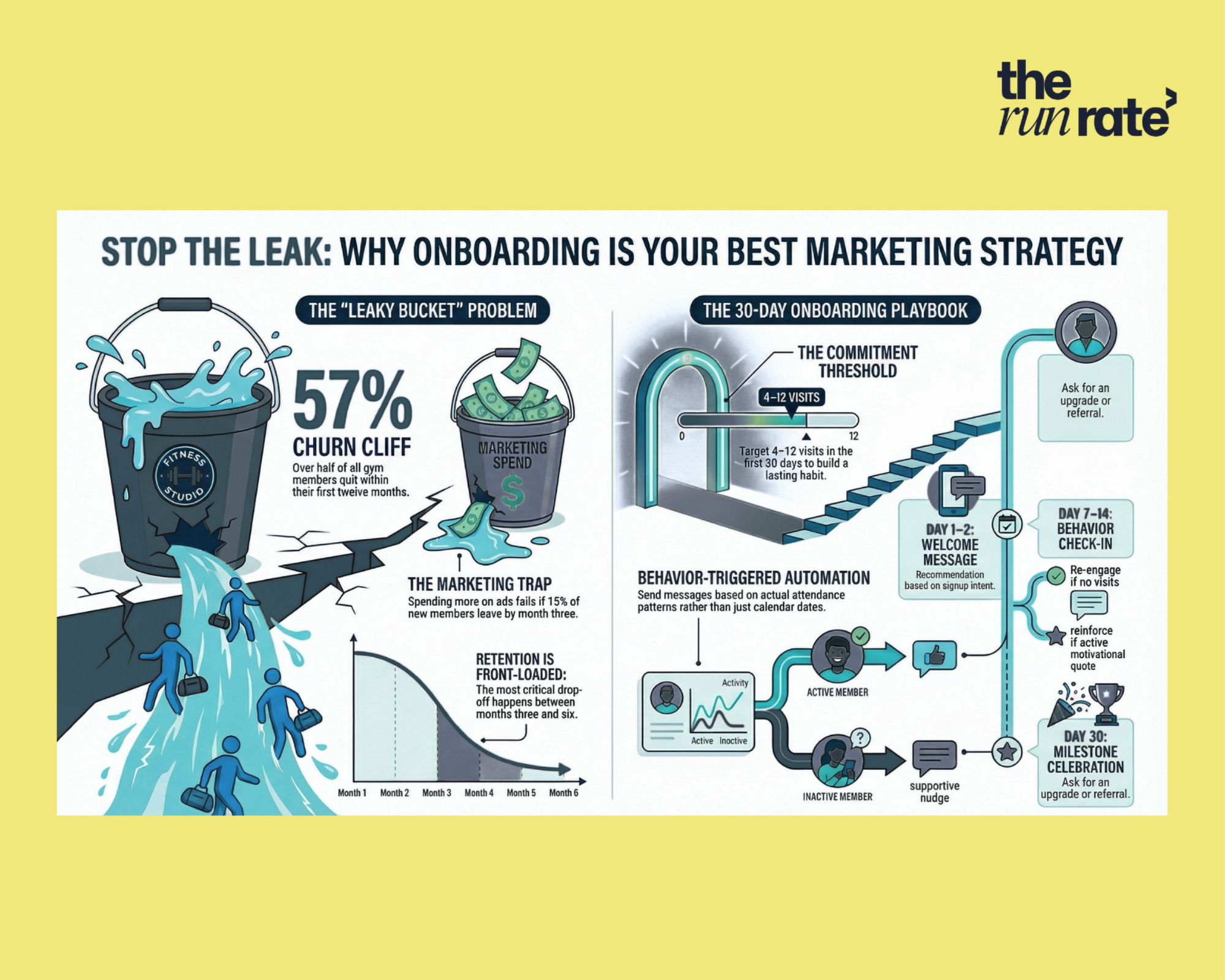
The data tells a different story. Industry benchmarks show 50% of new gym members quit within their first six months (HFA). Boutique studios retain better, but even the best lose 20–30% annually. And the drop-off isn’t gradual. It’s front-loaded: 15% of new members are gone by month three. 35% by month six. 57% by month twelve (Bedford & Tock, HFA Show 2025).
That’s not a marketing problem. That’s an onboarding problem.
The studios growing consistently have identified what they call the “commitment threshold” — the point at which a new member has built enough habit that they’re unlikely to quit. Research places the optimal early engagement zone at 4–12 visits in the first 30 days — below four, churn risk is high; above twelve, burnout sets in (Bedford, Retention Guru). The entire game is building that habit before the window closes.
Most studios have no structured workflow for this. The winning ones have an automated sequence that starts the moment someone buys their first membership — touchpoints at day 3, day 7, day 14, and day 30, each triggered by visit behaviour, not calendar timing.
Fix the front door, and the back door takes care of itself.
---
WHAT’S WORKING
The 10-visit onboarding sequence.
High-retention studios — consistently above 80% annual retention (Association of Fitness Studios, 2024) — share one operational pattern: an automated onboarding sequence built around a single goal. Get new members into a consistent visit habit in the first 30 days.
The mechanics vary, but the structure is consistent:
Day 1–2: Welcome + class recommendation based on signup intent
Day 7: Check-in. Visited? Positive reinforcement. Didn’t visit? Re-engagement offer — free guest pass, personal training intro
Day 14: Progress nudge. Reference their specific classes, instructor, community
Day 30: Milestone celebration + commitment ask — upgrade, refer a friend, book ahead
Each touchpoint triggers on actual visit behaviour, not calendar. A member who’s been three times in 7 days gets a different message than one who hasn’t been back since day one.
Is your tool supporting this natively?
---
TOOL OF THE WEEK
Keepme — AI-powered member retention for gyms
What it does: Predicts which members are at risk of churning before they cancel — using visit patterns, engagement data, and behavioural signals. Automatically triggers retention outreach when a member crosses a risk threshold.
Who it’s for: Mid-size to large gym chains and studio groups. Needs clean member data and an existing CRM to perform.
Verdict: Loved this and it’s the most purpose-built retention AI for gyms on the market as far as I’ve tested. Not a general AI tool dressed up for fitness. Worth evaluating if retention is your primary growth lever. But we know it should be.
THE NUMBER
57%
Percentage of gym members who have churned by month twelve (Bedford & Tock, HFA Show 2025). The studios consistently above 80% annual retention aren’t outspending competitors on acquisition. They’re outperforming them in the first 30 days.
THE PLAYBOOK
[FREE] The 10-Visit Onboarding Sequence
The structure high-retention studios use to get new members past the commitment threshold in 30 days. Four touchpoints, triggered by behaviour — not calendar.
Download free: therunrate.co/playbooks
WHO TO FOLLOW
Greg McCoy - 4x gym owner behind @hidden_gym. Greg shares the real work of running multiple locations — community programming, coaching culture, and what it actually takes to keep members coming back. No vendor pitch. Just an operator who’s figured out retention by doing it 4 times over.